Diagnostic Landscape
What is the current situation?
There has been a massive increase in the need for diagnostic services within England and Wales in recent times with the NHS anticipating that there are approximately 5.6 million[1] patients waiting for treatment. This record number is ever increasing and with illnesses such as Cancer increasing at a rate of 2% per year, healthcare services are being put under immense pressure. At this rate by 2035 there will be 742 cases per 100,000 people[2] The need for diagnostic reformation is emphasised by the NHS commissioned report by Sir Mike Richards dated Oct 2020[3].
The ever-increasing backlog
As per the Organisation for Economic Co-operation and Development (OECD) averages, the United Kingdom is behind the mean number of imaging scanners per million population[5]. When coupled with the increase in need for effective diagnostics and staffing shortages, this is worrying and an area for concern that needs rapid intervention.
What is the NHS Long Term Plan?
The NHS Long Term Plan is set to transform the way the NHS operates. Its aim is to create and develop a service fit for the future. A pivotal focus of the plan is around diagnostics and screening which need to be reformed allowing for a patient focused and efficient service. Often, the waiting times once referred to a hospital by a GP have led to delays of weeks and even months before diagnostic tests are carried out. The COVID 19 pandemic has allowed for all those involved within the healthcare system to revise methods of working and adapt new ways to reduce this waiting time.
The Solution
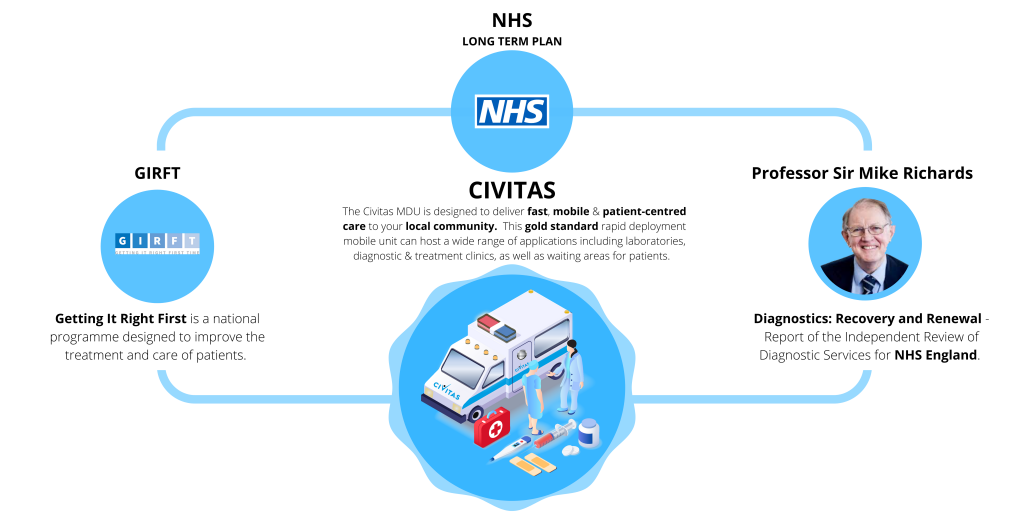
Professor Richards discusses the importance of investment of new service delivery models, equipment and facilities.
The provision of mobile diagnostics units allow for treatment close to patient’s homes. These units can include various departments and separate areas such as Radiology or Cardiology. Each CIVITAS MDU is built for rapid deployment and can be effectively moved to a different area whereby services are quired. The units can hold within them not only diagnostic equipment but also those machines relating to dentistry or audiology.
NHS Long Term Plan
Previously more traditional approaches were provided for diagnostics in acute settings, i.e hospital-based. This followed the pathway of a GP referral to a hospital consultant. Several weeks would ensue between referrals, diagnostics and tests, not including the additional delays with further tests and appointments.
Now faced in a post-pandemic landscape, opportunities to redesign patient pathways are available. The needs of primary care and commissioners must be taken into account as well as improved access and productivity in secondary care all provided in new environments.
Getting It Right First (GIRFT)
GIRFT recommends diagnostics and tests to be delivered in a community-based setting, with increased and appropriate use of GP direct access. In order to reduce the number of journeys to hospitals, reduce ‘Referral To Treatment’ times and drive productivity and efficiency, it is essential to join up primary and specialist follow-up care in settings that are closer to patients homes.
‘Hot’ & ‘Cold’ sites
Addressing health inequalities
In order to address the issue of long-term health inequalities, community-based healthcare, especially in areas of deprivation, is essential. These issues have been amplified by the pandemic, and to ensure post-pandemic reduction of these inequalities, Mobile Units are essential.
Making Healthcare Accessible
Following the recommendations made in ‘Diagnostics: Recovery and Renewal (2020)’ our MDUs provide a pragmatic solution to the growing pressure on services within the NHS and a viable option allowing healthcare services to adapt to a much more modern approach.
Diagnostic and screening services are important in early intervention of patient care but are often inaccessible due to lack of appointments, inability or reluctance to travel to hospitals and long waiting room times.
Our MDUs allow for viral diagnostics to be carried out in a safe but remote setting therefore negating the above and providing a viable alternative.
If there is a COVID 19 outbreak, our MDU can be rapidly deployed to carry out testing and vaccinations safely.
Civitas’s vision is far-sighted and believes the scope for the MDU is endless.

Cardiovascular
• Stroke I Head
• Heart
• Sleep

Fitness
• Heart
• Musculo-skeletal
• Pulmonary

Wellness
• Breast
• Osteoporosis
• Heart
• Gynae
• Bowel
• Prostate
• Liver

Health
• Mental Health
• Sleep
Making Healthcare Accessible
The Diagnostics: Recovery and Renewal (‘Richards Report’) outlines that NHS should significantly consider the introduction of out-of-hospital care in order to reduce the diagnostic backlog NHS England is facing.
Professor Sir Mike Richards, in his report, outlines how a huge amount of investment and reform is required within the critical diagnostic services. This includes equipment and facilities, workforce, new service delivery models, digitisation and connectivity in order to reduce the backlogs, as well as improve the capacity and efficiency of the services.
1. https://www.standard.co.uk/news/uk/nhs-sajid-javid-england-health-secretary-stephen-powis-b954574.html.
2. https://www.cancerresearchuk.org/health-professional/cancer-statistics/incidence/
3. https://www.england.nhs.uk/wp-content/uploads/2020/11/diagnostics-recovery-and-renewal-independent-review-of-diagnostic-services-for-nhs-england-2.pdf.
4. https://www.theguardian.com/politics/2021/jul/10/sajid-javid-warns-nhs-waiting-lists-backlog-could-reach-13m
5. https://www.england.nhs.uk/statistics/statistical-work-areas/diagnostics-waiting-times-and-activity/monthly-diagnostics-waiting-times-and-activity/
Disclaimer: CIVITAS UK is not responsible for the content of third party websites